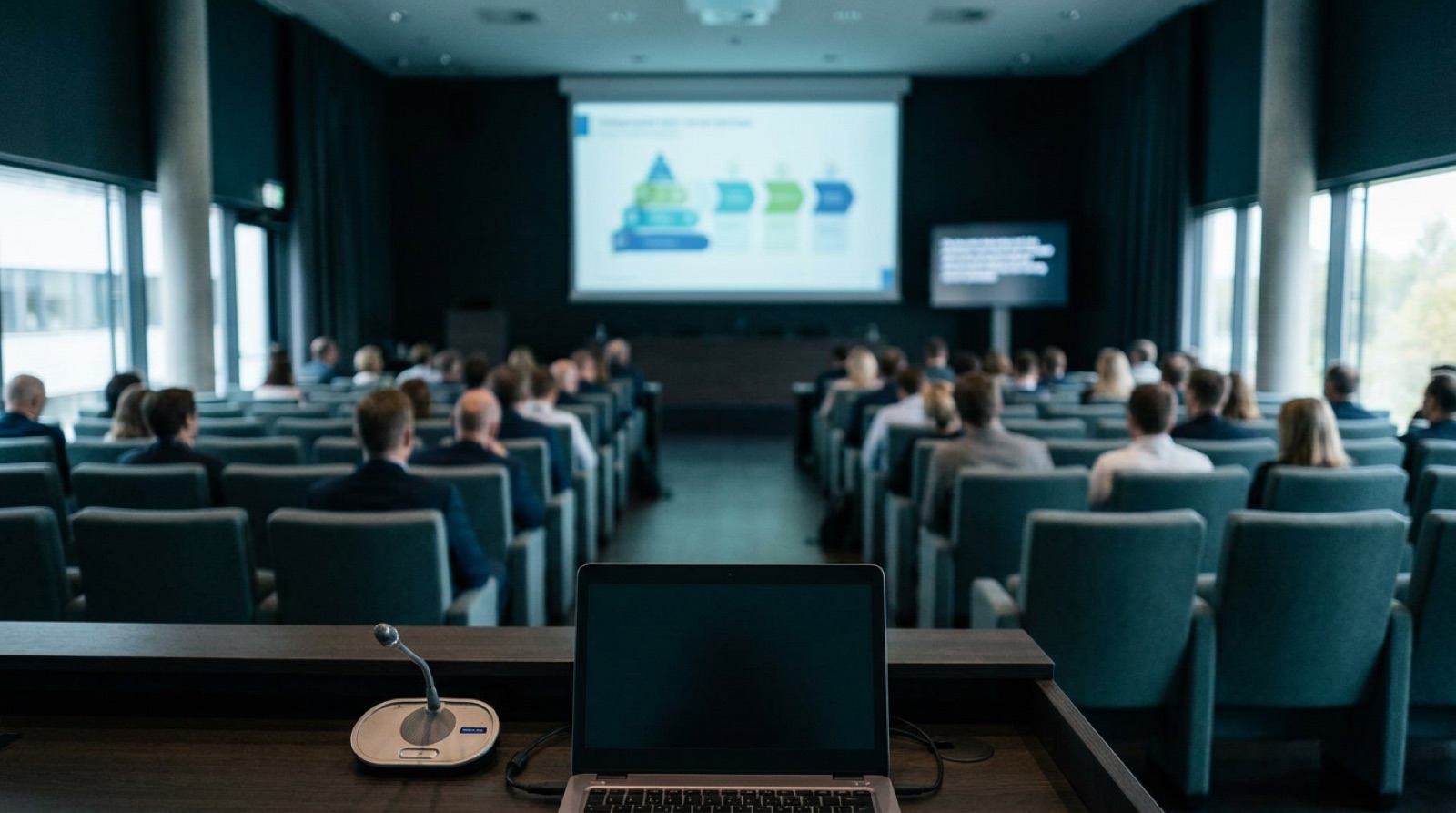
A conference audience facing a presentation screen with a live caption display beside it.

Certified RCP-M CART Provider · NVRA Certified

Every word. As it’s said.
By a human being.

Precision Captions LLC provides live, human-generated remote CART captioning for classrooms, ceremonies, lectures, and conferences. Not a machine guessing at your speaker’s accent. A trained, certified professional writing every word in real time — and a polished transcript in your hands within two hours.

RCP-M Registered CART Provider – Master
97.5% Certification accuracy standard
2 hrs Transcript turnaround
Live Remote captioning, any platform

The Human Difference

AI captions are a rough draft.
Yours deserves better.

Automatic speech recognition — the AI behind every “auto-caption” button — has improved. It still is not access. It has no ear for a heavy accent, no patience for crosstalk, no idea what your subject matter actually is — and no way of knowing when it is confidently wrong.

Written by a certified captioner

Biology lecture

The mitochondria synthesize ATP during oxidative phosphorylation.

Commencement

Nguyen Thi Hoa, Bachelor of Science, summa cum laude.

Constitutional law lecture

PROFESSOR: Turn to Miranda v. Arizona, 384 U.S. 436.

Generated automatically — AI

Biology lecture

The mitochondria synthesized eight TP during oxidative phosphor relation.

Commencement

When Tee Wah, Bachelor of Science, summer cum loud.

Constitutional law lecture

[no speaker ID] Turn to Miranda the Arizona, three eighty four US four thirty six.

Illustrative examples of documented AI captioning failure modes: unfamiliar terminology, proper names, and missing speaker identification. Note that every error above is fluent, confident, and plausible — which is exactly what makes it dangerous. A reader has no way to tell it is wrong.

A certified human captioner

  • Hears context, not just sound. Knows that “mitosis” and “my toes is” are not the same word in a biology lecture.
  • Prepares before the event. Names, acronyms, course terminology, and technical vocabulary are loaded in advance.
  • Identifies who is speaking. Essential in panel discussions, seminars, and classroom debate.
  • Captures the room. Laughter, applause, an alarm in the hallway — the things a transcript needs to make sense.
  • Adapts live. A speaker goes off script, the audio degrades, an accent is unfamiliar — a human adjusts.
  • Is accountable. There is a certified professional responsible for the quality of your access.

Automatic speech recognition — AI

  • Degrades sharply with accents, fast speech, and multiple talkers.
  • Has no advance knowledge of your terminology, names, or subject matter.
  • Typically omits speaker identification entirely.
  • Ignores environmental sound and non-speech information.
  • Fails silently — errors arrive fluent, plausible, and wrong.
  • Answers to no one when a student misses the key term in a lecture.

How many words actually arrive correctly

Every bar below measures the same thing: the share of spoken words that reach the reader correctly, live, as it is being said. These are not laboratory benchmarks and not polished-afterward transcripts — they are real-time measurements on real lecture audio and real conversations. Longer is better.

Certified human CART provider 98–99%

Every room, every speaker, every time. This is the number you are buying.

RCP-M certification minimum 97.5%

The floor a provider must clear to be certified — not the ceiling.

AI live captions — best case, clean audio, one clear speaker ~89%

The live-streaming average across eleven AI services on university lecture audio.

Why this number deceives It is an average, and nobody sits through an average. The same study measured individual recordings all the way down to 54% of words wrong. Using AI, you are not getting 89% — you are getting a lottery ticket whose result you learn after the event.

AI captions — speakers of non-standard dialects ~65%

Measured across five major commercial AI systems. More than 1 word in 3 lost.

Why this number deceives This is the average for one dialect group. Your event does not have “a dialect” — it has a different one at every microphone, and the AI cannot tell that the speaker changed. See what that does to a real room ↓

AI captions — worst real lecture measured ~46%

Same services, same study, a genuine lecture recording. Over half the words gone.

Why this number deceives Nothing warned anyone this was the bad day. The captions still looked like captions — fluent, confident, arriving on time. A student cannot tell a 46% transcript from a 99% one while reading it.

AI captions — deaf speaker ~22%

Roughly 4 words in 5 are wrong. This is not a transcript. It is noise.

Why this number deceives It looks like an edge case in a chart. It is the moment a deaf student speaks in class and the room reads gibberish attributed to them. The technology fails hardest at the exact instant accessibility matters most.

Where the averages fall apart

One event. Many voices. The AI hears only one.

Every accuracy figure ever published assumes a speaker. Your event has a dozen. A commencement has a name reader and four hundred surnames from as many linguistic backgrounds. A seminar has a professor, a guest, and whoever speaks up from the back. The moment the voice changes, the problem resets — and only one of these two notices.

The same event, minute by minute Certified human captioner AI captioning
The professor you have captioned all semester Knows the cadence, the pet phrases, the course vocabulary. Near-perfect from the first word. Handles it. This is the case the marketing numbers are built on.
A guest lecturer with an unfamiliar accent Recalibrates within a sentence or two, then holds accuracy for the rest of the hour. Applies the same acoustic model it always does. Accuracy drops and stays down.
A student speaking a non-standard dialect Hears a dialect, not an error. Transcribes what was actually said. Nearly twice the error rate of a standard-dialect speaker — measured across five commercial systems.
An international student presenting Reads context and subject matter to resolve unfamiliar phonology. Asks for the slide deck beforehand. Substitutes the nearest common English word. The substitution reads perfectly.
Rapid crosstalk in Q&A Marks who is speaking and keeps the thread of the argument intact. Merges voices into one undifferentiated stream. The disagreement becomes unreadable.
A deaf attendee speaks Captions them with the same care as everyone else in the room. Roughly 4 words in 5 wrong. The room reads nonsense attributed to a person who is present.

This is the difference the percentages cannot show you. A human captioner is not a transcription rate — they are a listener who adapts, in real time, to whoever is at the microphone. AI applies one fixed model to every voice and degrades silently against the ones it was trained on least. Averages describe a room that does not exist. Precision Captions is hired for the room that does.

Sources: best-case and worst-case AI figures are from an evaluation of eleven commercial ASR services on higher-education lecture recordings. Streaming (live) transcription averaged 10.9% word error versus 9.37% for batch — a statistically significant gap — and individual samples ranged to 53.8% word error. Kuhn et al., Measuring the Accuracy of Automatic Speech Recognition Solutions, ACM Transactions on Accessible Computing, 2024 (arXiv:2408.16287). Dialect figure: average 35% word error rate for Black speakers versus 19% for white speakers across five commercial ASR systems — Koenecke et al., Racial disparities in automated speech recognition, PNAS, 2020 (PNAS). Deaf-speaker figure: 78% word error rate (arXiv:2109.10412). All shown as accuracy equivalents. Human CART accuracy — 121 Captions. RCP-M standard: 97.5% sustained over a 22.5-minute dictation at speeds up to 225 words per minute, with a drop-down rate of five seconds or less — NVRA Certifications.

CART provides “complete communication access by capturing the spoken word as well as any environmental sounds.” National Verbatim Reporters Association

Specialties

The events where getting it wrong is not an option

General-purpose captioning handles general-purpose speech. These are the settings that break it — and the ones Precision Captions is built for.

An illustration of prepared script pages flowing into a live caption display.

Script Captioning

Scripted programs, ceremonies, theatrical productions, and corporate presentations where the words are known in advance. The script is prepared, formatted, and cued ahead of time, then delivered live in perfect sync — with a human ready the moment a speaker departs from the page. Which they always do.

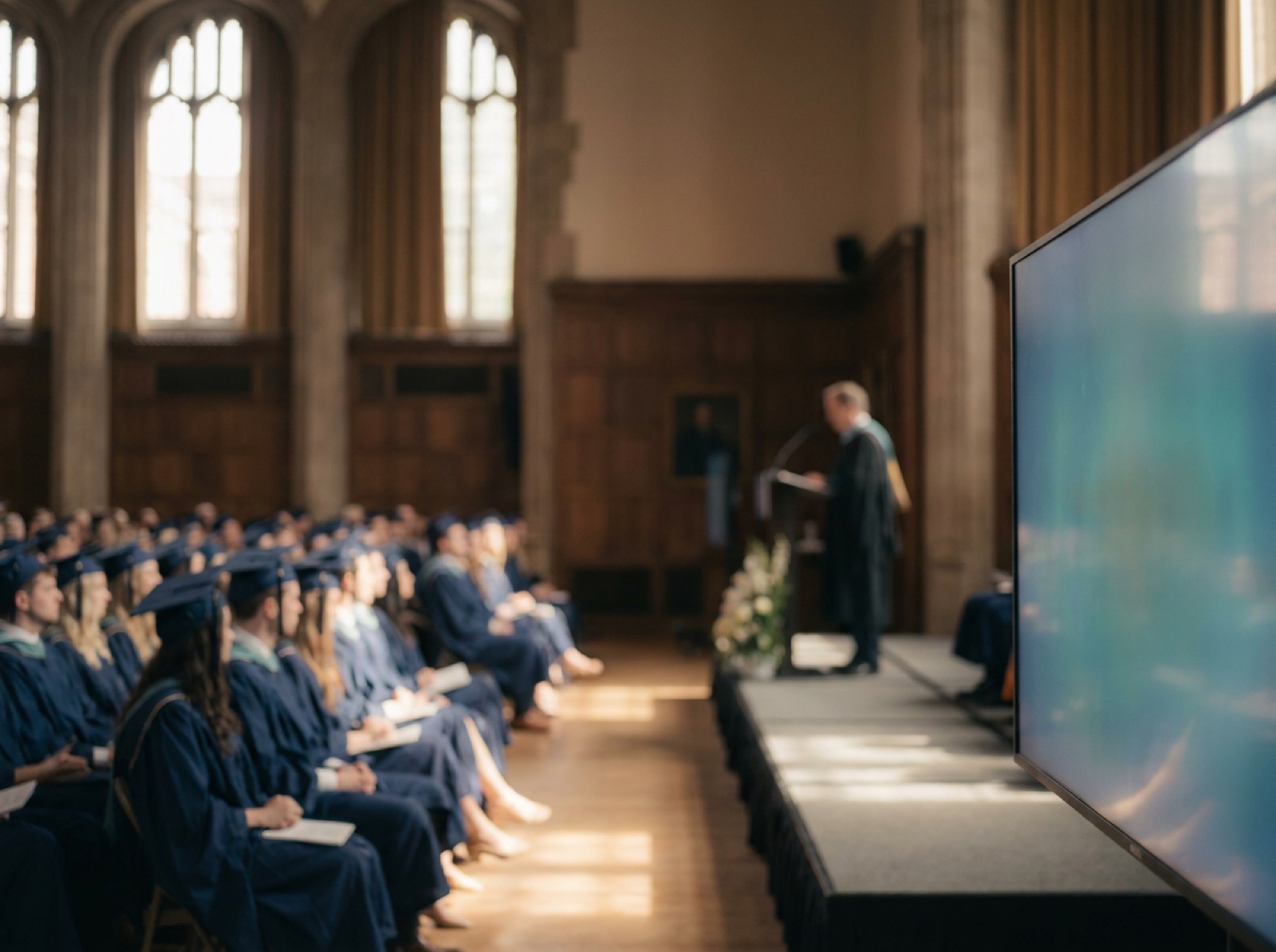
Graduates seated in a hall facing a stage with a caption display to the side.

Graduations & Ceremonies

Commencement is unforgiving: hundreds of proper names, many of them uncommon, read at speed, in a room with difficult acoustics, on a day nobody gets to repeat. Name lists are loaded and rehearsed in advance so every graduate’s name appears on screen correctly — the moment it is called.

A university lecture hall where a student follows a live text display on a tablet.

Classroom & Technical

Captioning a lecture means knowing the vocabulary before the lecture starts. Precision Captions prepares subject-specific terminology for each course and each instructor.

  • Scientific & medical
  • Mathematical
  • Law & pre-law coursework
  • Engineering & technical
  • Financial
A conference audience facing a presentation screen with a live caption display beside it.

Conferences & Meetings

Panels, keynotes, training sessions, and all-hands meetings, captioned remotely. Speaker identification keeps a fast-moving discussion followable, and every attendee can read along on the room screen or on their own device.

Services

What Precision Captions provides

Live CART Captioning

Communication Access Realtime Translation, delivered remotely. The spoken word converted to text instantaneously and displayed on a monitor, a personal device, or a large screen for the room.

Platform Integration

Captions delivered natively into the platform you already use — Zoom, Microsoft Teams, Webex, Google Meet, and streaming or hybrid setups. No special software required of your audience.

One-Cap & StreamText

Extensive experience with the One-Cap App and StreamText delivery, so participants can follow captions on their own device, at their own text size, wherever they are seated.

Transcript Generation

A clean, formatted transcript delivered within two hours of project completion — ready for students, minutes, compliance files, or distribution to attendees.

Advance Preparation

Agendas, slide decks, name lists, glossaries, and scripts are reviewed and loaded before the event. Preparation is where accuracy actually comes from.

Remote & Hybrid Events

Fully remote captioning for distributed teams, hybrid conferences, and online coursework, with the same certified provider and the same standard of accuracy.

How It Works

Straightforward, start to finish

  1. 1

    Tell us about the event

    Date, duration, setting, platform, and how many people need access. A quote comes back promptly.

  2. 2

    Send the materials

    Scripts, agendas, slide decks, name lists, reading lists, and any specialized terminology. Everything gets prepared in advance.

  3. 3

    Captions go live

    On screen in the room, in your meeting platform, or on each participant’s own device via One-Cap or StreamText.

  4. 4

    Transcript delivered

    A formatted transcript in your inbox within two hours of the event ending.

A captioner's workstation with a broadcast microphone, headphones, and handwritten preparation notes.

About

Captioning is a craft, not a feature

Precision Captions LLC is a certified captioning practice built on a straightforward conviction: people who rely on captions deserve the same quality of information as everyone else in the room. Not the gist. Not most of it. All of it.

The work is credentialed. The Registered CART Provider – Master (RCP-M) certification from the National Verbatim Reporters Association requires sustaining 97.5% accuracy across a 22.5-minute dictation at variable speeds up to 225 words per minute — with a drop-down rate of five seconds or less. It is a demanding standard, and it exists because live access has to be right the first time.

What that certification does not measure is the part clients notice most: arriving prepared, communicating clearly about logistics, sorting out the audio feed before it becomes a problem, and getting the transcript back before anyone has to ask for it.

  • Registered CART Provider – Master (RCP-M)
  • NVRA Certified
  • Remote live captioning
  • One-Cap App & StreamText experienced
Get Started

Request captioning for your event

Tell us what you need covered. You’ll get a straight answer on availability and cost — no automated runaround.